
Difficulty Adjustments and Why Estimates Age Quickly
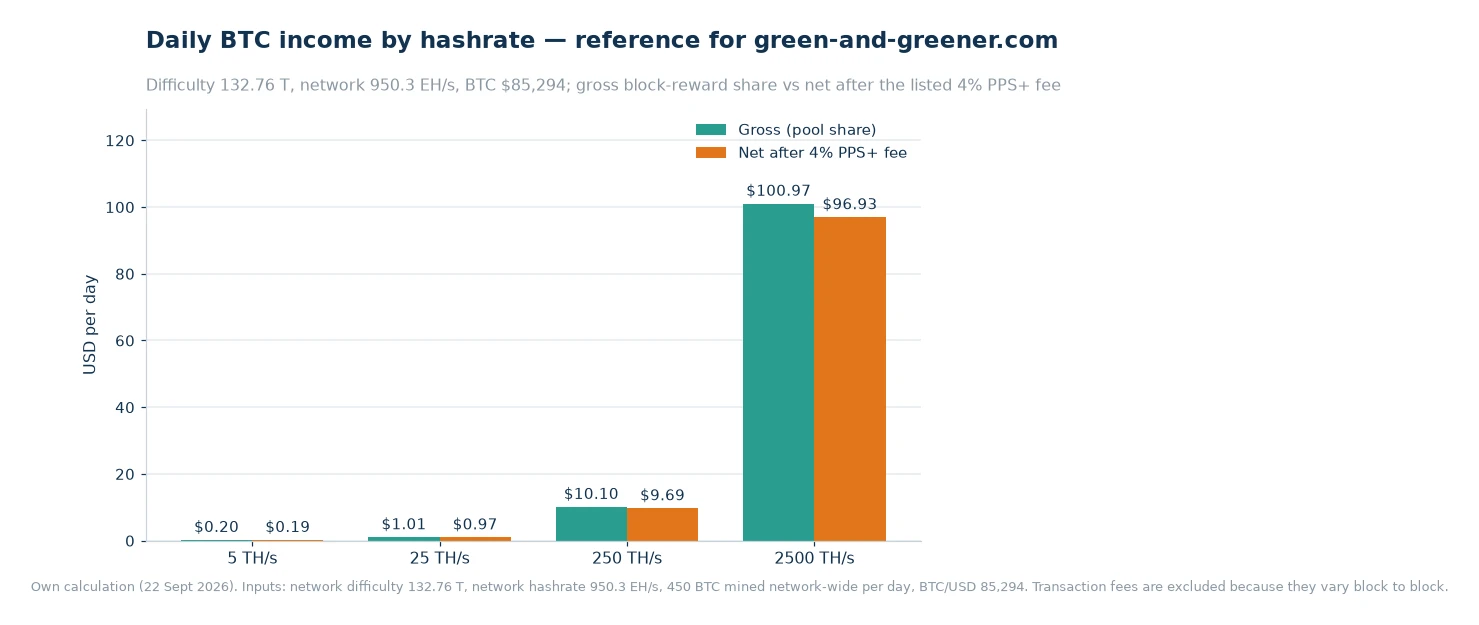
Bitcoin difficulty is 132.76 T and the next adjustment is estimated at +1.90%, which is enough to move a 250 TH/s machine from about $10.10 a day of gross income to roughly $9.91 without a single change to the hardware. Any estimate you saved last month already describes a network that no longer exists, because difficulty is set by everyone else.

Key takeaways
- One terahash of SHA-256 produces 0.0000004735 BTC a day at 132.76 T — about $0.0404 gross and $0.0388 after the listed 4% PPS+ block-reward fee.
- If the estimated +1.90% adjustment lands, per-terahash income falls from $0.0404 to roughly $0.0396 a day on the block-reward component.
- A 2.5 PH/s fleet earns about $1,357.02 net across a 14-day adjustment window, so a 1.9% move is worth roughly $25 inside that window.
- Rebuild the estimate when difficulty, price or your own effective hashrate changes instead of storing one figure and assuming it still holds.
Why an estimate carries an expiry date
Difficulty is recalculated every 2,016 blocks, which on Bitcoin's ten-minute target works out to about 14 days. Inside that window the conversion from terahash to coin is fixed by protocol: your share is your hashrate divided by total network hashrate, and nothing you switch on or off moves the denominator in your favour.
Between windows the denominator drifts continuously as machines start and stop around the world, and the protocol pulls the block interval back toward ten minutes by moving difficulty. That arithmetic gives 950.3 EH/s of implied network hashrate at 132.76 T today. An independent three-day average puts the same figure at 942.8 EH/s, which is a useful reminder that even the denominator is an estimate with a percent or two of slack in it.
A calculator output is therefore a snapshot of three moving inputs and one steady one. Price moves inside the hour. Network hashrate moves continuously. Difficulty moves once every 14 days. Your own machine count and your listed fee rate are the parts you control, and they are also the parts that matter least while the network keeps growing.
What one percentage point of difficulty costs
Per-terahash income scales exactly inversely with difficulty. Multiply difficulty by 1.019 and output per terahash is divided by 1.019. At 132.76 T a single terahash earns 0.0000004735 BTC a day, which is $0.0404 at a BTC price of $85,294, and the listed 4% fee on the PPS-settled block reward leaves about $0.0388.
If the estimated adjustment lands, the same terahash returns roughly 0.0000004647 BTC, or $0.0396 gross and $0.0381 net. That is a 1.9% cut applied to every terahash in the fleet at the same moment. Transaction fees are left out of every figure here because they vary block by block and cannot be derived from difficulty.
| Difficulty scenario | BTC per TH/s per day | Gross per TH/s | Net per TH/s after the listed 4% PPS+ block-reward fee | 250 TH/s net per day | 2,500 TH/s net per day |
|---|---|---|---|---|---|
| Current, 132.76 T | 0.0000004735 | $0.0404 | $0.0388 | $9.69 | $96.93 |
| Estimated +1.90%, about 135.28 T | 0.0000004647 | $0.0396 | $0.0381 | $9.51 | $95.12 |
| A 1.90% decrease instead, about 130.24 T | 0.0000004827 | $0.0412 | $0.0395 | $9.87 | $98.77 |
Worked example: one window at 2.5 PH/s
Take a fleet of 2,500 TH/s, which is 2.5 PH/s. The whole calculation is four lines.
Line one. Convert the network figure: 950.3 EH/s is 950,300,000 TH/s, so the fleet holds 2,500 / 950,300,000, or about 0.00000263 of the network.
Line two. Apply that share to daily issuance: 0.00000263 times 450 BTC is about 0.0011838 BTC a day, worth $100.97 at $85,294 per BTC.
Line three. Deduct the listed 4% fee that applies to the PPS-settled block reward: 0.0011838 BTC becomes roughly 0.0011364 BTC, or $96.93 a day. That is about $4.21 an hour, and under PPS+ it settles hourly at current difficulty.
Line four. Re-run the window with difficulty up 1.9%: $96.93 divided by 1.019 is $95.12 a day. Across 14 days, net income drops from about $1,357.02 to roughly $1,331.68 — a difference of $25.34 that simply appears in the books.
Rebuild the number instead of remembering it
The fix is a re-estimation habit rather than a better stored figure. Four inputs carry all the weight: effective hashrate, current difficulty, the listed fee that applies to the component you are reading, and the BTC price. Change one input and the answer moves by exactly the ratio of that change, which makes the sensitivity easy to run by hand before you commit to anything.
A tool that takes those inputs directly removes most of the arithmetic. The Profit Calculator in the tools section returns a daily estimate from hashrate, difficulty, price and the fee rate, and it includes merged-mining output where a coin has a merge-mined partner, which matters if the fleet is not running SHA-256 alone.
The quickest sanity check needs no software: divide your own hashrate by the implied network hashrate, multiply by 450 BTC, then take off the listed fee share. If the result is far from the saved estimate, the saved estimate is the one that is wrong, and the ViaBTC Mining Calculator is a fast way to re-derive it against live difficulty instead of a figure typed in three weeks ago.
Two secondary inputs deserve a place beside the main four. Realised uptime comes first, because a fleet running at 96% availability earns 96% of the estimate and difficulty has nothing to do with the shortfall. Second, if the account mines more than one algorithm, keep the other coin's price and hardware earning rates separate rather than blending them into one number that fits neither.
Where estimates usually go wrong
- Using a headline hashrate without a date. Implied hashrate of 950.3 EH/s and a three-day average of 942.8 EH/s differ by about 0.8%, which is real money at fleet scale.
- Applying the fee to the wrong base. The listed 4% applies to the PPS-settled block reward under PPS+; the transaction-fee component follows PPLNS logic at a listed 2%, and merging the two misstates the deduction.
- Forgetting the clock. An estimate built before an adjustment describes the previous difficulty window, which is exactly the mistake a 14-day cycle invites.
- Turning one good day into a run rate. A single strong day at one BTC price says nothing about the next window if difficulty is drifting upward.
- Comparing net against gross. The Miner Profitability Ranking and most calculators show figures that differ on exactly this point, so match the basis before comparing two machines.
Frequently asked questions
How often does Bitcoin difficulty change?
Every 2,016 blocks, which works out to roughly 14 days at the ten-minute target block interval.
Does a difficulty increase reduce my hashrate?
No. Your terahash count stays the same; what falls is the coin and dollar value each terahash earns, because the same 450 BTC a day is now shared across more network hashrate.
How stale is an estimate after one adjustment window?
At an estimated +1.90%, roughly 1.9% stale on the block-reward line — about $25 across 14 days at 2.5 PH/s, which is small per window and larger across a year of upward moves.
Keep the estimate honest
Write the four inputs next to every estimate you keep, along with the date you read them, so the figure can be audited later instead of argued about. Re-run the arithmetic after each difficulty adjustment, after any price move large enough to change a decision, and whenever the fleet size changes. Estimates work best as a running comparison rather than a fixed promise, and the ones that stay useful are the ones you rebuild most often.
Data and sources: ViaBTC listed fee schedule[1] and the pool statistics page[2]. Network difficulty (132.76 T), implied network hashrate (950.3 EH/s), the independent three-day average (942.8 EH/s), daily issuance of 450 BTC and the BTC price of $85,294 come from public chain data and market feeds; read 22 Sept 2026. Every figure is arithmetic on those inputs and moves with difficulty and price.