
From Bottle Spec to Delivered Pallet: Packaging Steps for a Spa Line
Packaging a spa line goes wrong when steps run in parallel without an owner, not when any single step is difficult. A sequence matters because each stage produces the input for the next: the format decides the specification, the specification decides the proof, the proof decides the print run, and the print run decides whether the delivery date is real.
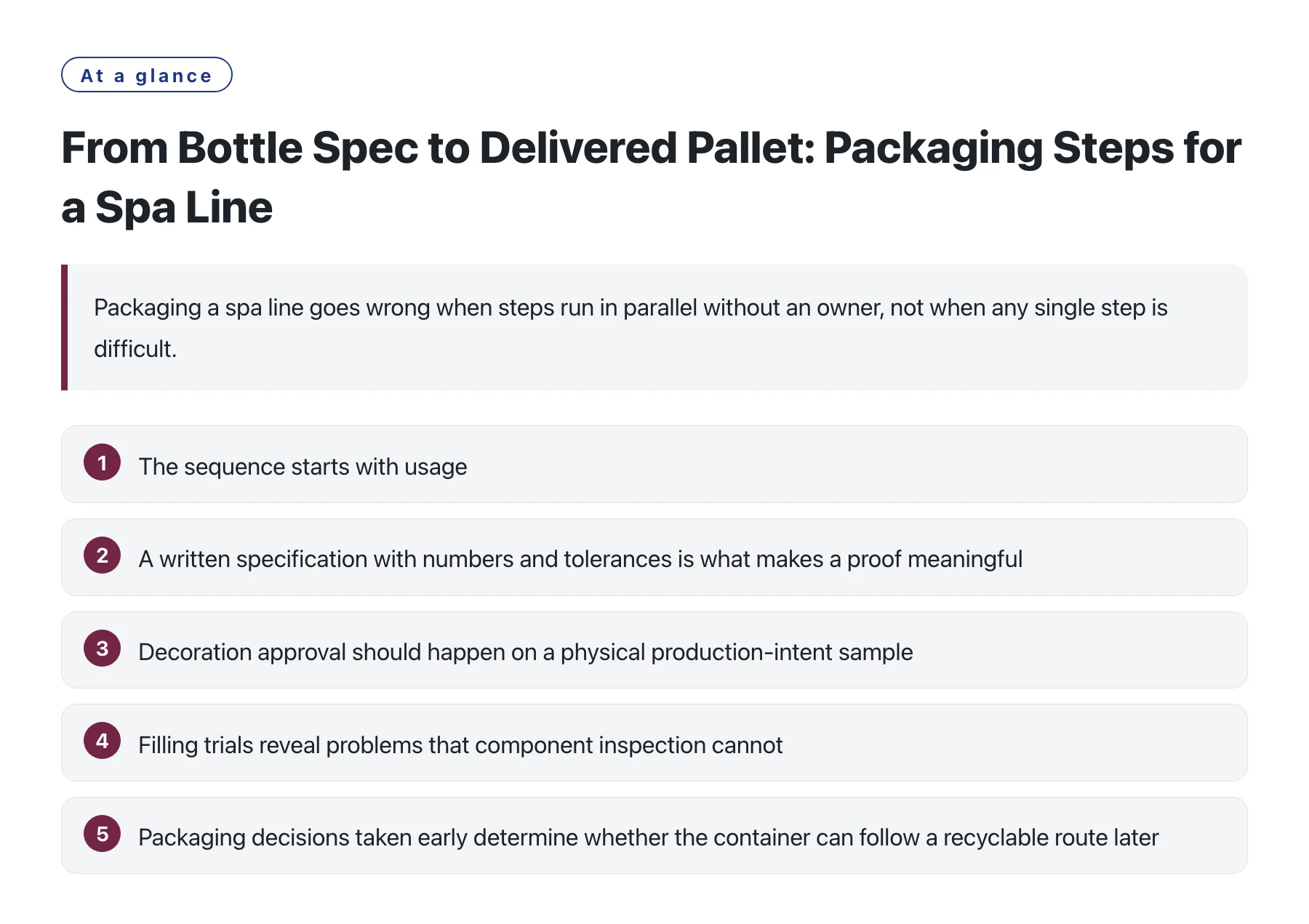
Key takeawaysThe sequence starts with usage, not appearance: format, fill size, closure and where the product will be handled come before any container is selected. · A written specification with numbers and tolerances is what makes a proof meaningful, because a proof can only be checked against something specific. · Decoration approval should happen on a physical production-intent sample, not on a digital mock-up or a screen proof. · Filling trials reveal problems that component inspection cannot, particularly around closures, pump output and leak behaviour. · Packaging decisions taken early determine whether the container can follow a recyclable route later, so material and decoration choices belong together [1]. · Independent inspection before shipment is worth budgeting where the packaging is complex, because it shifts the discovery of a fault to before the pallet leaves [2]. · Any change to a component after tooling or print has to pass through the same sequence again, which is why the specification should be treated as a controlled document [3].
A spa line usually launches under a fixed date: a season, a reopening or a group rollout. The packaging sequence is the part of the project most likely to compress that date, because it depends on external tooling, print and transport rather than on internal work.
The following steps describe the order in which packaging decisions can be settled without having to reopen an earlier one. It is written for the person coordinating the project, who has to keep the specification, the supplier and the property's operations team aligned.
The packaging sequence, step by step
- Define use before appearanceWrite down where the product is used, how it is refilled or replaced, who handles it and what the fill size must be. This paragraph becomes the brief for the container conversation and prevents a shape-led decision.
- Set the format and the closure classChoose refillable, bulk-fill or sealed single-use, and state whether tamper evidence is required. The format determines the neck finish, the closure options and the cleaning procedure that operations will have to run.
- Write the specification with numbersFill weight with tolerance, closure torque or engagement, spray or pump output where relevant, leak-test method and drop or transport expectations. Adjectives cannot be inspected; numbers can.
- Select components against the specificationMatch bottle, closure, pump and any dispenser to the specification, and confirm compatibility with the fragrance rather than assuming it. Record the chosen part numbers and their tolerances.
- Approve decoration on a physical proofPrint, coat or decorate a production-intent sample and approve on that object, in the intended light, with the colour standard recorded. Digital proofs are useful for layout and unreliable for colour and finish.
- Run a filling trialFill, close, pack and handle a trial batch. This is where closure torque, pump priming, leaking and carton fit get tested together, and where most late problems are found while they are still cheap.
- Inspect, freeze and deliverConfirm the first production run against the frozen specification, check the pallet configuration and labelling, and record the delivery against the retained reference and batch documents.
Where the sequence usually gets compressed, and what it costs
The most common compression is decoration approval. A digital file is approved because the launch date is tight, the print run starts, and the colour or the finish is wrong on the physical product. Recovering from that costs a reprint and, in many cases, a delayed delivery, so the physical proof is the cheapest step in the sequence to protect.
The second compression is the filling trial. Skipping it means the first time bottle, closure and carton meet is in the production run. Problems that would have been corrected in a trial batch then appear at production scale, where every fix is more expensive and the schedule has less room.
The third is the specification freeze. If the specification can still change after tooling or print, the sequence has no controlled baseline, and every subsequent conversation is about which version was agreed. Freezing the specification and routing changes through a stated process keeps the sequence intact.
There is also a market dimension that packaging teams sometimes meet late. Rules on packaging and packaging waste are evolving in several jurisdictions, and a design that was acceptable a few years ago may need revisiting for recyclability or packaging reduction reasons [3]. Checking this before the container is selected is much easier than changing it afterwards.
Keep operations in the loop
The people who restock and clean will notice problems that a specification cannot describe: a cap that is awkward with wet hands, a dispenser that drips, a bottle that does not fit the tray. Bringing them into the filling trial stage turns their experience into a design check rather than a complaint after rollout.
Choosing the manufacturing route for the packaging work
Some brands source the container, the decoration, the filling and the carton separately, and others hand the whole sequence to one supplier. Splitting the work can give more control over component choice; combining it reduces the number of handovers where a fault can hide. The right answer usually depends on how unusual the packaging is.
Where the line is intended to run for years across several properties, the combined route has an operational advantage: the same party holds the specification, the decoration standard and the fill record, so a reorder repeats without a new round of approvals. A supplier that offers private label fragrance production typically works this way, with a defined packaging range and a repeatable process.
Where the packaging is the brand's main differentiator, splitting may be worth the coordination cost, but the brand then owns the compatibility and schedule risk. Whichever route is chosen, the sequence above still applies; only the number of parties between the steps changes.
It is also useful to know which combinations of format and packaging are already in production in your segment. Case material such as Xuelei case studies is marketing rather than evidence about your own project, but it does show which routes are practical at volume, and that is a reasonable input when the packaging direction is still open.
The shape of a supplier's offer is usually visible before any conversation begins. Xuelei's official website sets out which stages a manufacturer presents as its own, and the useful exercise is to lay that list beside the sequence above and mark every step that neither side has claimed. The unclaimed steps are where the delays will appear.
If the launch date is fixed, protect the two steps that cannot be recovered quickly: the physical decoration proof and the filling trial. Everything else in the sequence can absorb a small delay by working in parallel, but a reprint or a redesign after a failed production run cannot. Build those two into the plan with slack, not as optional extras.
Sources
- Sustainable Packaging Coalition —— A membership organisation working on more sustainable packaging design, publishing material and recyclability guidance.
- SGS: Cosmetics, Personal Care & Household Testing —— Testing, inspection and certification services for cosmetics and personal care, including microbiological, stability and safety testing aligned with cosmetics GMP.
- European Commission: Packaging Waste and the PPWR —— EU rules on packaging and packaging waste, including the Packaging and Packaging Waste Regulation requirements on recyclability and design.
Frequently asked questions
How long does the packaging sequence take for a spa line?
It depends almost entirely on whether tooling is involved and how many decoration passes are required. Standard components with a single decoration step move quickly; a custom mould plus several print passes takes considerably longer. Ask for the sequence as a dated plan rather than a single lead-time figure.
What should a bottle specification include for a hotel or spa product?
Fill weight with tolerance, closure type and engagement, pump or dispenser output, material, decoration standard, compatibility requirements with the formula, and the tests the components must pass. Anything that will be checked at delivery should appear in the specification.
Can decoration be approved from a digital mock-up?
It can be approved for layout, but not for colour, finish or registration. Those require a physical production-intent sample. The cost of that sample is small compared with a print run that has to be repeated because the result did not match the expectation.
Who should own the packaging specification?
One named person, with a written process for changes. The specification is the reference every later stage depends on, so if two teams can edit it independently, the sequence loses its baseline and disagreements become a question of which version was current.
Is a pre-shipment inspection necessary for amenity packaging?
It depends on the complexity and the value of the run. Where several components, decoration passes and carton configurations are combined, an inspection before shipment is usually cheaper than discovering a fault after the pallet has travelled, because rework or replacement can be organised locally.
See your real Scope 1–3 baseline in 14 days.
A 20-minute live demo with a solutions engineer — no slides, no greenwashing, just your data flowing through the platform.